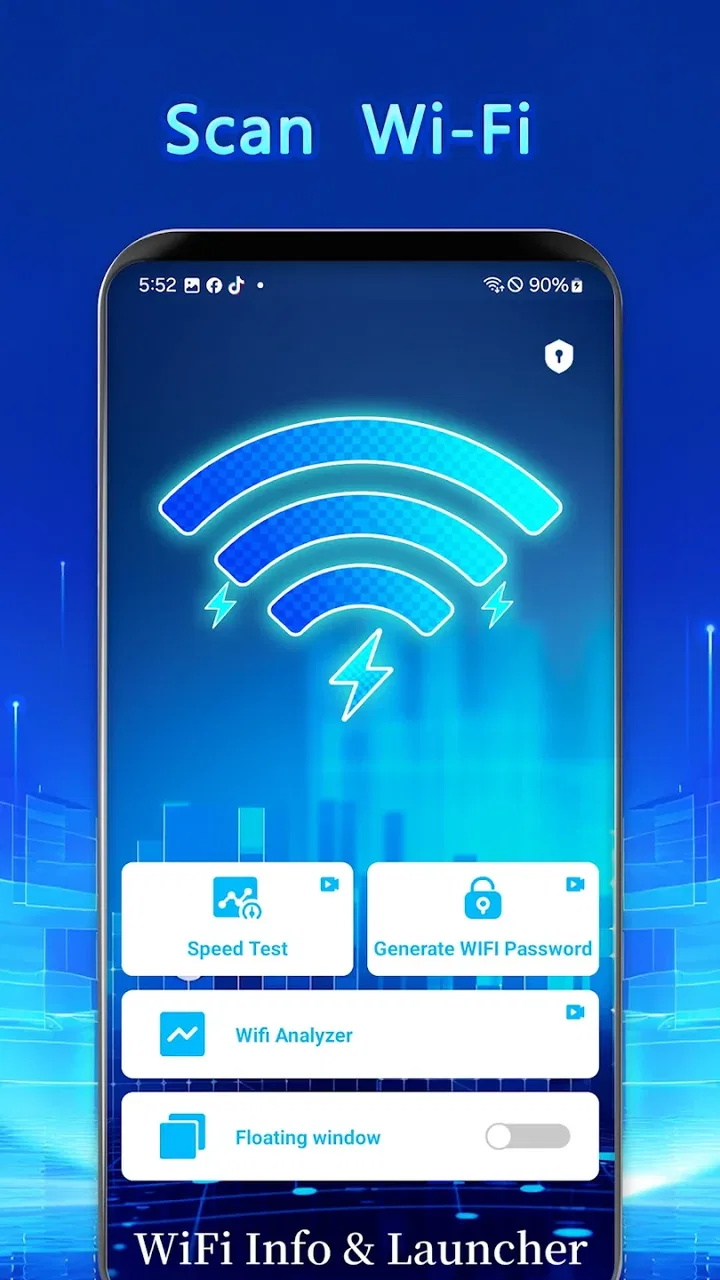
WiFi Info & Launcher
- 4.3
- Rating
- 100.00K
- Installs
- Free
- Price

 Analysis by App-foxy
Wi-Fi problems rarely arrive as dramatic failures. More often, they are small interruptions: I need to check which network my phone is using, find connection details, move between saved networks, or reach a network-related setting without searching through several Android menus. Each task takes only a moment, but repeated moments become irritating. WiFi Info & Launcher is built around that everyday annoyance, offering an Android launcher focused on managing networks rather than trying to become a complete phone replacement.
After using it as a focused Wi-Fi information tool, I found its appeal easy to understand. It is free, aimed at everyone, and comes from RUITA LIMITED. Its store summary describes an Android launcher that manages networks easily, while the shorter description keeps the idea simple: WiFi Info. That narrow purpose is important. This is not an app I would install for entertainment or broad device customization; I would install it when network access and network-related shortcuts are the part of Android I want to reach more directly.
Making network access less repetitive
The first thing I would do after installing WiFi Info & Launcher is treat it as a practical utility, not as a replacement for every part of the Android interface. The current version is 1.0, and the app supports Android 10 or later. That makes the compatibility question straightforward: users on an older system should not plan around it, while people with a recent Android phone can consider it without needing a complicated setup strategy.
You May Also Like

 Pandora - Music & Podcasts
Pandora’s Music Is Easy to Start, but Harder to Recover
Pandora’s strength is its low-effort path from a seed to a station. Its weak spot is how much confidence it asks you to place in connection, setup, and quiet recovery.

 AccuWeather: Weather Radar
AccuWeather Review: A Quick, Clear Forecast for Everyday Decisions
For everyday plans, the best forecast is the one you can understand quickly. AccuWeather makes rain timing, radar, and local conditions easy to act on, with a few trade-offs.

 Hill Climb Racing
Why Hill Climb Racing Still Turns Crashes Into One More Run
A tiny car, a bumpy hill and one more upgrade: Hill Climb Racing keeps resurfacing because its simple chaos makes every near-miss feel personal.

 AliExpress - Shopping App
AliExpress Makes Global Shopping Feel Personal, but Shoppers Bear the Risk
AliExpress turns a global marketplace into a pocket-sized discovery engine. Its reach is useful, its shopping loop compelling, and its trade-offs easy to miss.

 Lords Mobile: Kingdom Wars
Lords Mobile Is a Kingdom-Building Routine, Not a Quick Match
A case-by-case verdict on the building, battles, device demands, and social commitments that make Lords Mobile rewarding for some players and exhausting for others.

 PDF Scanner app - TapScanner
TapScanner Makes Paperwork Easier to Capture, Check, and Share
TapScanner makes scanning with a phone feel less like a rescue operation and more like a dependable step in getting work done. Its capture tools are useful, though not flawless.
More From Our News Desk
View All News


The useful starting point is to decide what I actually want the launcher to solve. If my problem is repeatedly opening Android’s network area, checking the active connection, or getting to Wi-Fi controls with fewer steps, the app has a clear role. If I expect it to improve signal strength, repair a weak router, or provide a full network diagnostic suite, I would be setting the wrong expectation before opening it.
I also recommend spending a few minutes learning its route to network information instead of judging it after a single tap. Launcher-style tools are most helpful when their entry point becomes familiar. The benefit is not necessarily a dramatic new capability; it is the reduction of small decisions between noticing a network issue and reaching the relevant screen. That distinction matters because the app’s value is measured in repeated convenience rather than in a long list of advanced controls.
For a first setup, I would keep the arrangement conservative. I would use the app as an additional route to network management before making it the main way I interact with the phone. This gives me a chance to see whether its organization fits my habits. Someone who changes networks often may appreciate the dedicated focus immediately, while someone who checks Wi-Fi only once every few weeks may find the normal Android settings perfectly adequate.
One practical tip is to test the app in the places where network confusion usually happens, not only at home. I would check it while connected to a familiar router, after moving to another saved network, and when the phone is using mobile data instead. Those situations reveal whether the launcher helps me identify the current state quickly. A tool that feels unnecessary in a quiet home environment can become more useful when I am moving between home, work, public access points, and temporary connections.
What the focused design does well
The strongest idea here is concentration. Android already contains network controls, but they are part of a much larger operating system. A dedicated launcher can make sense for users who do not want to remember where those controls sit after a system update or who prefer a network-centered starting point. I value that kind of specialization when it removes navigation rather than adding another complicated dashboard.
There is also a useful mental advantage. When I open a general settings app, I have to scan several categories before deciding where to go. A network-focused utility reduces that search. This is especially helpful for family members who understand “open the Wi-Fi tool” more easily than “open Settings, choose the correct connection section, then find the relevant option.” The Everyone age rating also makes the app approachable for a broad audience, although simple access does not automatically mean every Android interface will feel identical.
The app’s rating sits at 4.3 from around 150 ratings, with about 20 written reviews. That is a modest but encouraging reception rather than a reason to assume universal satisfaction. I read that kind of signal as evidence that the basic idea works for a defined group, while still leaving room for individual differences in Android versions, phone layouts, and personal expectations.
Where it fits into an ordinary day
Imagine I leave home in the morning and arrive at a workplace or café where my phone has previously connected to more than one network. Before starting a video call, I want to know whether the phone is actually using the intended Wi-Fi connection or quietly relying on mobile data. Instead of wandering through general settings, I open the network-focused launcher and use it as my first checkpoint. The time saved may be brief, but the important part is avoiding uncertainty before the call begins.
A second scenario is troubleshooting without immediately blaming the router. If a page loads slowly, I first want to distinguish between being connected to the wrong network and having a broader connectivity problem. A focused information screen gives me a sensible first step: identify the connection state, then decide whether to reconnect, move closer to the access point, or investigate elsewhere. This does not fix the underlying issue by itself, but it can stop me from taking the wrong troubleshooting path.
The app can also be useful when helping another person. Family tech support often fails because instructions depend on slightly different phone layouts. Rather than describing a long sequence through Android settings, I can point the person toward one network-oriented entry point. That makes the conversation shorter and reduces the chance that they tap an unrelated option. The trade-off is that both people need to understand what this launcher is for; it is a shortcut to network management, not a universal remote control for the phone.
Travel is another reasonable use case. When I move between a hotel, a transport hub, a rented apartment, and mobile data, the network shown by the phone can change frequently. A dedicated Wi-Fi utility gives me a consistent place to begin checking the connection. I would still be careful with public networks and would not treat a convenient information screen as a security guarantee. Convenience helps me see and manage the connection; it does not make an unfamiliar network trustworthy.
For people who maintain several home access points, the app’s value depends on how often they need to inspect or switch among them. Someone testing coverage from room to room may appreciate a faster way to reach network information. However, users who need channel analysis, detailed signal graphs, router administration, or a complete wireless survey should look for a specialist network analyzer instead. The focused nature that makes this app approachable also limits how far it can go as a technical diagnostic instrument.
Small workflow improvements I would use
My preferred workflow would be to use the launcher at the start of a network check, then return to normal phone use once I know what is happening. I would not keep opening it without a question in mind. That habit prevents a utility from becoming another layer of tapping. The app is most effective when it answers a specific need: Which connection is active? Where do I reach the network controls? Am I checking Wi-Fi before changing other settings?
Another useful habit is to check the connection before changing multiple things at once. When a phone behaves strangely online, users often toggle Wi-Fi, restart applications, switch mobile data, and move around the room in quick succession. A focused launcher encourages a more orderly first step. I can inspect the network situation, make one change, and then see whether the result improved. That is not a flashy feature, but it is a better troubleshooting method and can save more time than random tapping.
I would also use it as a teaching aid for someone learning Android. The app’s narrow purpose gives beginners a concrete place to start when they ask about Wi-Fi. After they understand the connection screen and basic network controls, they can decide whether they still need the shortcut. In that sense, it can serve either as a lasting convenience or as a bridge toward becoming comfortable with the standard system interface.
There is a subtle trade-off in relying on a launcher rather than Android’s built-in route. A shortcut can be easier today, but operating-system updates may change how network controls behave behind the scenes. If a path ever feels different, I would compare the app’s behavior with the phone’s native settings instead of assuming the phone itself is malfunctioning. Keeping that fallback in mind makes the utility safer to use as a convenience layer.
How it compares with the usual alternatives
The obvious alternative is Android’s built-in network settings. Those controls have the advantage of being already present, familiar to the operating system, and capable of handling the broader connection workflow. If I only need to connect to a new network occasionally, the native option may be enough and avoids installing another app. WiFi Info & Launcher becomes more attractive when repeated access is the problem, especially for users who want a dedicated network starting point.
A second alternative is a full Wi-Fi analyzer. Such apps are better suited to people who want technical information for improving router placement, comparing wireless conditions, or investigating crowded channels. They can be more informative, but they are also more demanding and may distract from a simple task such as checking the active network. I would choose the analyzer for diagnosis and this app for quick access and everyday network management.
Some phones also offer manufacturer-specific shortcuts or quick settings tiles. Those can be faster if they are already configured well, and they may integrate more deeply with the device. On the other hand, their placement and appearance vary by manufacturer. A focused third-party launcher can provide a more consistent idea across supported Android devices, though the exact experience still depends on the phone’s software environment.
The important comparison is therefore not “which app has the most features?” I would ask which route removes the most friction for my particular routine. Native settings win for zero-install simplicity. Advanced analyzers win for technical investigation. This app occupies the middle ground: a lightweight, network-centered path for people who want practical access without turning every connection check into an engineering project.
Where the convenience stops
The main limitation is the app’s narrow scope. An Android launcher focused on networks cannot replace a router’s administration panel, a security tool, or a professional wireless survey. I would not choose it if my goal were to diagnose interference, measure performance over time, manage parental controls, or inspect every technical property of a local network. Those jobs require tools designed specifically for them.
There is also a question of habit. If I already use Android’s quick settings confidently, adding another entry point may not save me anything. In fact, it can create a small amount of duplication: I have the system controls, the launcher, and perhaps a manufacturer shortcut all pointing toward similar tasks. The app earns its place only when its route feels clearer or faster in my daily routine.
Version 1.0 is another reason I would keep expectations measured. A first release can have a clean central idea, but long-term usefulness depends on how well it keeps pace with Android changes and different device interfaces. I would pay attention to whether the launcher remains dependable after system updates and whether its network access continues to feel direct rather than becoming another layer of navigation.
Privacy-minded users should apply the same sensible caution they use with any utility that interacts with connection-related areas. I would review the app’s requested access during installation and avoid assuming that a simple interface tells me everything about how it operates. The free price is attractive, but “free” should not replace normal judgment about permissions and device behavior. This is particularly important when using it on a phone that contains work accounts or sensitive information.
Performance expectations should also stay realistic. The app can help me reach and organize network-related actions, but it cannot turn a weak connection into a strong one. If the problem is distance from the router, congestion, an outage, or an authentication failure, the launcher may only help me identify the next step. That is still valuable, provided I see it as a time-saving access tool rather than a repair utility.
Who should install it?
I would recommend WiFi Info & Launcher to Android users who frequently switch networks, help other people with connection settings, or want a dedicated route to Wi-Fi information. It is also a sensible choice for someone who finds the standard settings structure unnecessarily buried. The free price lowers the barrier to trying it, and the Everyone rating makes it suitable for a wide range of users who need a simple network-oriented utility.
I would skip it if I rarely touch Wi-Fi settings, already have a convenient system shortcut, or need advanced wireless diagnostics. In those cases, the built-in Android controls or a dedicated analyzer would be a better match. I would also avoid treating it as a universal launcher; its usefulness comes from specialization, and expecting a broader feature set would make the app seem weaker than it needs to be.
RUITA LIMITED has kept the concept direct: make network access easier to reach on compatible Android devices. The app has reached over 100 thousand installs, which suggests that the problem is common enough to attract a real audience, while its current release remains a focused tool rather than a mature all-purpose platform. I see that as a reason to judge it by routine convenience, not by the number of extras it does not need.
My final view is positive but specific. WiFi Info & Launcher is worthwhile when the repeated act of finding Wi-Fi information is the annoyance I want to remove. It can shorten a familiar workflow, make connection checks easier to explain, and provide a clearer first stop when I am unsure which network the phone is using. Its limits are equally clear: it does not replace advanced network analysis, router controls, or Android’s native settings for everyone.
If you often lose time navigating to network controls, I think this free utility is worth trying on Android 10 or newer. If your connection problems require measurements and deep diagnosis, choose a specialist tool instead. For me, the app succeeds not because it promises to solve every Wi-Fi problem, but because it targets one recurring interruption and makes the first useful action easier to reach.
FAQs for WiFi Info & Launcher
01What is WiFi Info & Launcher and how does it work?
WiFi Info & Launcher is a comprehensive app designed to provide users with detailed information about their WiFi connections. It offers insights into network strength, speed, and security. Additionally, it includes a launcher feature for quick access to commonly used apps. By integrating connectivity details with user-friendly access, it enhances your device's functionality.
02Is WiFi Info & Launcher safe to use on my device?
Yes, WiFi Info & Launcher is safe to use. The app is regularly updated to ensure user privacy and security. It does not collect personal data without consent and adheres to standard privacy protocols. Always download the app from trusted sources like Google Play Store or Apple App Store to avoid malicious versions.
03Can I customize the launcher feature in WiFi Info & Launcher?
Absolutely! WiFi Info & Launcher allows users to customize the launcher feature by adding shortcuts to their favorite apps. This personalization ensures quick access to frequently used applications, enhancing the overall user experience. The interface is intuitive, allowing easy customization without any technical expertise required.
04Does WiFi Info & Launcher consume a lot of battery power?
WiFi Info & Launcher is designed to be efficient in terms of battery consumption. While it runs in the background to provide real-time WiFi information, it has been optimized to minimize battery drain. Users typically notice negligible impact on battery life, making it a practical choice for daily use.
05What kind of WiFi information does the app provide?
WiFi Info & Launcher provides a wide range of information including signal strength, connection speed, and network security details. It also offers insights into available networks and their respective signal qualities. This comprehensive data helps users make informed decisions about which networks to connect to for optimal performance.
Pros
- User-friendly interface for quick navigation.
- Detailed network information at a glance.
- Customizable widgets for easy access.
- Lightweight
- doesn't strain device resources.
- Fast connectivity checks and diagnostics.
Cons
- Ads can be intrusive at times.
- Limited features in free version.
- Manual refresh needed for updates.
- Occasional crashes on older devices.
- No support for certain network types.

WiFi Info & Launcher
Gallery